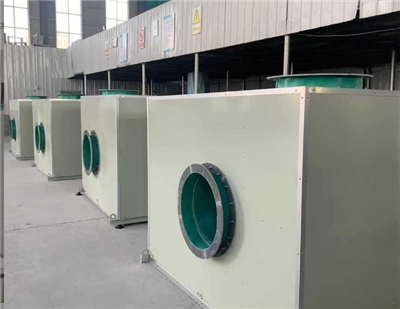
As a supplier of ventilation fans, I often receive inquiries from customers about how to calculate the power consumption of a ventilation fan. Understanding the power consumption of a ventilation fan is crucial for both cost - effectiveness and energy management. In this blog, I'll share some insights on how to calculate the power consumption of a ventilation fan.
Understanding the Basics of Power Consumption
Power consumption is typically measured in watts (W) or kilowatts (kW). The power consumption of an electrical device is determined by the amount of electrical energy it uses over a certain period. For ventilation fans, the power consumption depends on several factors such as the fan's motor efficiency, air volume, and static pressure.
The basic formula for calculating power (P) is given by the equation (P = VI), where (V) is the voltage and (I) is the current. In most cases, ventilation fans are rated with a power rating, which is usually provided by the manufacturer. However, this rating represents the maximum power the fan can consume under specific conditions.
Factors Affecting Ventilation Fan Power Consumption
Motor Efficiency
The efficiency of the fan's motor plays a significant role in power consumption. A more efficient motor will convert a higher percentage of electrical energy into mechanical energy, resulting in lower power consumption. Modern ventilation fans often use high - efficiency motors, which can save energy and reduce operating costs.
Air Volume
The air volume, measured in cubic meters per hour ((m^{3}/h)) or cubic feet per minute (CFM), is another important factor. A fan that needs to move a large volume of air will generally consume more power. The relationship between air volume and power consumption is not linear, but in general, as the air volume increases, so does the power consumption.
Static Pressure
Static pressure is the resistance that the fan has to overcome to move air through the ductwork or other ventilation system components. Higher static pressure requires more power from the fan. For example, if a ventilation system has a long duct with many bends and restrictions, the static pressure will be high, and the fan will need to work harder, thus consuming more power.
Calculating Power Consumption
Using the Manufacturer's Rating
The simplest way to estimate the power consumption of a ventilation fan is to use the manufacturer's power rating. This rating is usually given in watts. For example, if a fan has a power rating of 100 W, and it runs for 10 hours a day, the daily energy consumption can be calculated as follows:

Energy consumption (in watt - hours) = Power rating (in watts)×Time (in hours)
So, for a 100 - W fan running for 10 hours a day, the daily energy consumption is (100\times10 = 1000) watt - hours or 1 kilowatt - hour (kWh).
Calculating Based on Fan Performance Curve
In some cases, you may need to calculate the power consumption more accurately, especially if the fan is operating under non - standard conditions. This can be done using the fan's performance curve.
The performance curve of a fan shows the relationship between air volume, static pressure, and power consumption. To use the performance curve, you first need to determine the required air volume and static pressure for your ventilation system. Once you have these values, you can find the corresponding power consumption on the performance curve.
For example, if your ventilation system requires an air volume of (5000 m^{3}/h) and a static pressure of 200 Pa, you can look up these values on the fan's performance curve to find the power consumption at this operating point.
Example Calculation
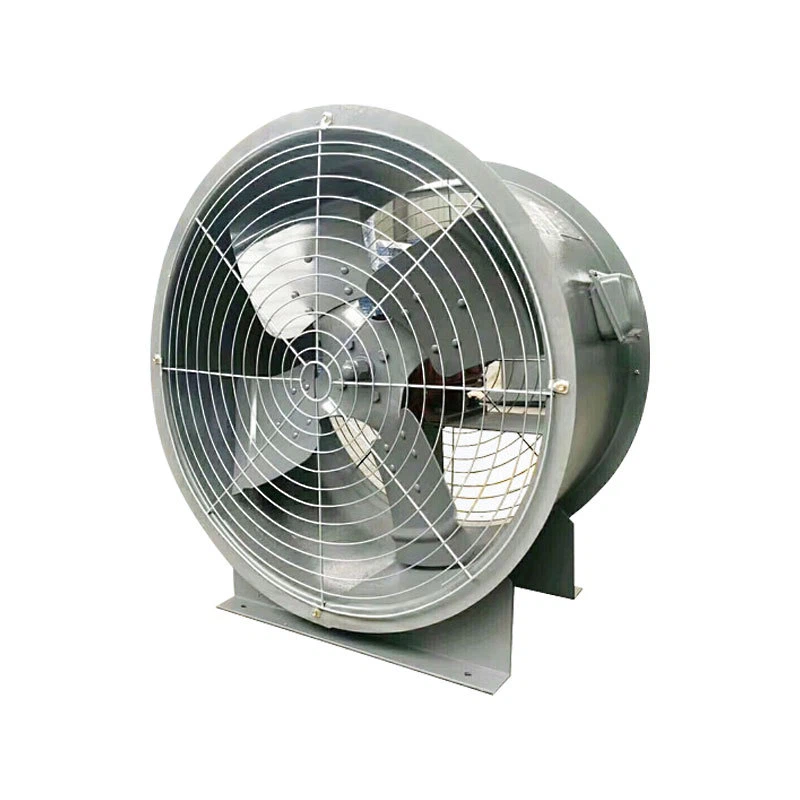
Let's assume we have an Industrial Axial Flow Fan with a power rating of 500 W. The fan runs for 8 hours a day.
The daily energy consumption is calculated as:
Energy consumption (in watt - hours) = (500\times8=4000) watt - hours or 4 kWh
If the cost of electricity is $0.15 per kWh, the daily cost of running the fan is (4\times0.15=$0.6)
The monthly cost (assuming 30 days) is (0.6\times30 = $18)
Different Types of Ventilation Fans and Their Power Consumption
We offer a variety of ventilation fans, each with different power consumption characteristics.
Industrial Axial Flow Fan
Industrial axial flow fans are commonly used in large - scale industrial applications. They are designed to move a large volume of air at relatively low static pressures. The power consumption of an industrial axial flow fan depends on its size and the required air volume. Larger fans with higher air - moving capacities generally consume more power.
Vertical Mixed Flow Fan
Vertical mixed flow fans combine the characteristics of axial and centrifugal fans. They are suitable for applications where both high air volume and moderate static pressure are required. The power consumption of vertical mixed flow fans can vary depending on their design and operating conditions.
Horizontal Mixed Flow Fan
Horizontal mixed flow fans are similar to vertical mixed flow fans but are installed horizontally. They are often used in ventilation systems where space is limited. The power consumption of horizontal mixed flow fans is also influenced by factors such as air volume and static pressure.
Importance of Calculating Power Consumption
Calculating the power consumption of a ventilation fan is essential for several reasons. Firstly, it helps in estimating the operating costs of the ventilation system. By knowing the power consumption, you can budget for electricity expenses accurately.
Secondly, it allows for energy - efficient design and operation of the ventilation system. By choosing a fan with the appropriate power rating and efficiency, you can reduce energy waste and contribute to a more sustainable environment.
Finally, understanding power consumption can help in troubleshooting ventilation system problems. If the power consumption of a fan is significantly higher than expected, it may indicate a problem such as a clogged filter or a malfunctioning motor.
Conclusion
Calculating the power consumption of a ventilation fan is a crucial step in managing the energy efficiency and operating costs of a ventilation system. By considering factors such as motor efficiency, air volume, and static pressure, you can accurately estimate the power consumption of your fan.
If you are in the market for a ventilation fan and want to learn more about power consumption or other technical aspects, we are here to help. Our team of experts can assist you in selecting the right fan for your specific needs and provide detailed information on power consumption and energy efficiency. Contact us to start a procurement discussion and find the best ventilation fan solution for your project.
References
- Fan Engineering Handbook, various editions
- ASHRAE (American Society of Heating, Refrigerating and Air - Conditioning Engineers) standards related to ventilation and fan performance.